An Occurrence at Owl Creek Bridge
A man escapes his own hanging. The reader believes him, up to the last paragraph.
What happens
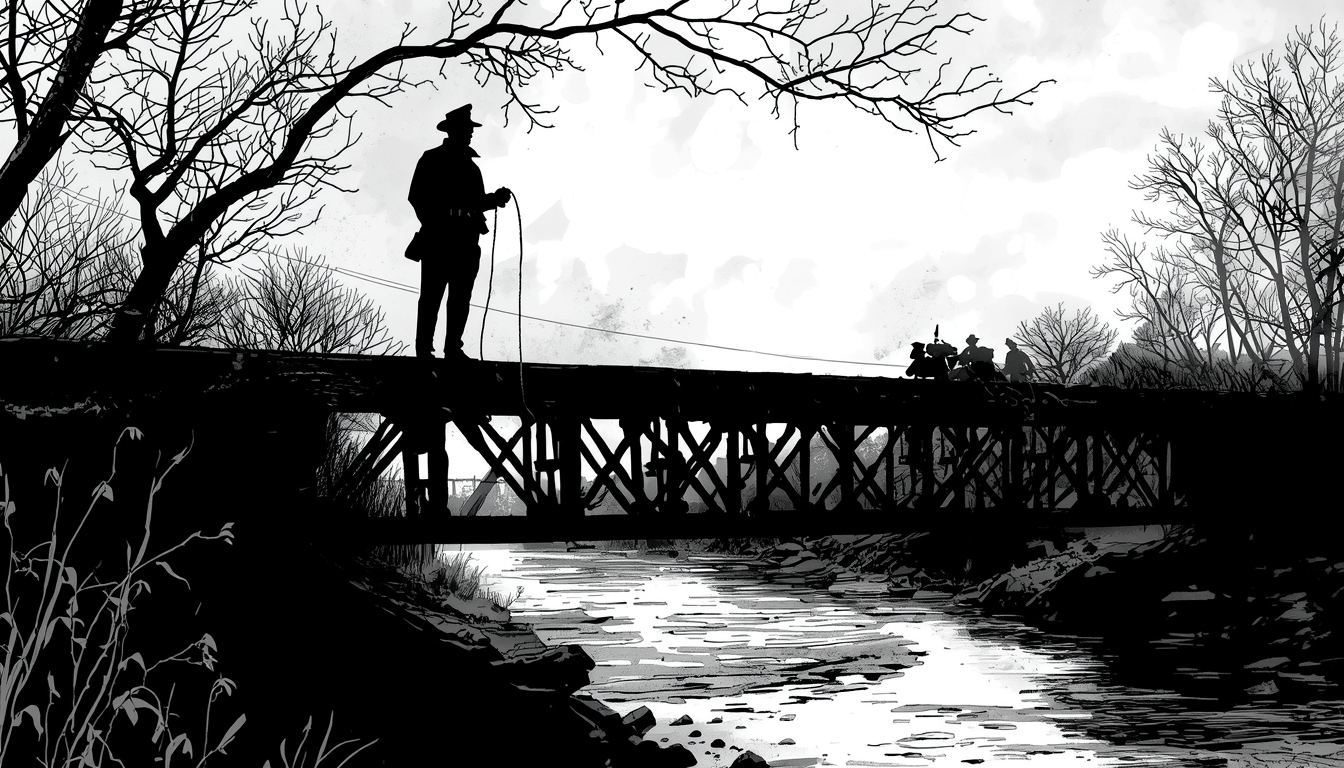
The story opens during the American Civil War: "A man stood upon a railroad bridge in northern Alabama, looking down into the swift water twenty feet below." His hands are bound and a rope circles his neck. He is Peyton Farquhar, a planter, caught after a Federal scout tricked him into trying to burn the bridge.
The rope breaks. He drops into the river, swims under fire, runs through the woods for what feels like a day and a night, and reaches his gate. His wife steps down from the veranda: "As he is about to clasp her he feels a stunning blow upon the back of the neck." The last line: "Peyton Farquhar was dead; his body, with a broken neck, swung gently from side to side beneath the timbers of the Owl Creek bridge."
Read the full text on Wikisource. First printed in the San Francisco Examiner, 13 July 1890.
Why it frightens
It is a trick played on the reader, and the fear is that you fell for it. Bierce writes the escape in vivid, sensory detail, then reveals it took place in the space between the drop and the stop. The mind, he suggests, can build a life in a second.
The scarier idea sits under the twist: you may not know when a story is over. Death arrives quietly while the person is still planning dinner. Bierce, who fought in the war, wrote the dying man's hopes with enough tenderness that the ending feels like an injury.
On screen
Neither film adapts Bierce's text. Each draws on the 1962 short film of the story: a mind that may be dying invents the world we watch.
- Jacob's Ladder (1990): director Adrian Lyne cites Robert Enrico's short film of the story as the source of its device: a long stretch of subjective time passing in an instant.
- Carnival of Souls (1962): loosely based on the 1961 French short of the story: a woman survives a car crash, then finds she cannot join the living world.